Monday, 23 July 2012

Sound problems

I was recently tearing my hair out attempting to get 32 bit games (and indeed any other type of software) to work on my 64 bit Linux system.  Every time I loaded them up they ran but without any sound whatsoever.  The error I was getting was:
Cannot open shared library libasound_module_conf_pulse.so
Upon searching the internet I found that I was not alone and it appeared to be a problem with the 32 bit sound libraries (well I could tell that without trawling the internet).  However according to the software available in the repos (Debian Sid/unstable) I had all of the necessary 32 bit libraries installed.

However reading through a post on the Zsnes forum, I found that the specific package (or the lack of it as the case may be) that was causing this problem was lib32asound2-plugins.  I had lib32asound2 installed, but lib32asound2-plugins did not appear to be in the Debian Sid/unstable repos.

I installed the package by downloading the deb file directly from here.  It does say to use the repos rather than downloading debs directly, however at this point I was out of luck.  After installing lib32asound2-pluigins all of my programs (OK then ...... games, if I'm being honest) now ran with sound.

Not the most technical of posts, however I hope that it is able to quickly help anybody else experiencing similar problems.

Wednesday, 2 May 2012

Updated: cross posting from Diaspora to identi.ca

Diaspora is widely described as the open source version of facebook and google+, however it is disappointing that, using your Diaspora settings, you can link with facebook, twitter and tumblr but not identi.ca. But there is a workaround.

In the spirit of this blog, I always try to keep everything open source, I'm going to link the accounts using brdcst.it a free, open source project by Michele Azzolari or @macno on identi.ca. Whilst brdcst.it is a free service; you need an invite, simply send an email to brdcst@brdcst.it

Once you have received your invitation log in to your new account at brdcst.it We'll do the destination first, trust me it's easier. I'll now break this into steps to make it easier to follow.

Before we can setup brdcst.it properly, we need the feed for your Diaspora posts.

1. On Diaspora, when you are about to make a post, you should see a text box similar to the one shown below:


Click on the spanner icon.

2. This will open up a new floating window, click on RSS, this will open up a new page. Take a note of the web page address.


In this example my address is https://joindiaspora/public/kevie.atom
*the recent rss feeds have .atom at the end

3. Go to the brdcst.it website.

4. On the welcome screen you'll see the number of feeds and destinations you currently have setup. Click on Add/Edit beside destinations, this will lead you to a new screen.

5. Click on Add new destination

6. Click on Identica

7. This will take you to identi.ca, log in (if necessary) and the site will display the message:
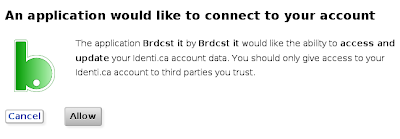

Click on Allow

8. Now go back to brdcst.it, this time click on Add/Edit beside feeds

9. In the first box add the address of your Diaspora feed that we noted in step 2. In the second box give this setup a name (I have imaginatively called it 'diaspora')


10. Now it's time to choose what you wish to export, for text only enter %s, if you want a link to be posted then add %u (you don't actually need this as it will be added automatically if your post exceeds the 140 character identi.ca limit)
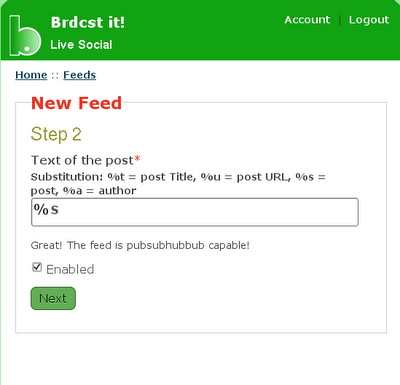


11. On the next screen, put a tick beside your identi.ca username and click on Save


12. Now log out of brdcst.it and your done, your posts from Diaspora will be updated on your identi.ca timeline.

Please note that when you post on Diaspora you must change from All Aspects to Public, only Public posts will be sent to identi.ca

Tuesday, 1 May 2012

Tizen 1.0 "Larkspur" is released.

Tizen, the Linux based mobile operating system that is replacing the short lived Meego project, is now out of beta and has announced it first full release codenamed "Larkspur".

In contrast to Mozilla's Boot2Gecko, which aims to use all of it's features on a cloud through a browser interface, Tizen adopts the more traditional format of the applications running natively on the mobile device.

The platform looks like it has been setup to meet the needs of the majority of users, with compatibility for various audio (both MP3 & Ogg Vorbis) and video files.  A full list of all the features of the new release can be seen here.

Tizen's graphics are a window system built upon X11, this includes support for OpenGL and indicates that it has the potential for both 2D and 3D graphics.  Web support appears to be embedded in the new code with full support for HTML5.

The official announcement from Tizen also stated " There are also a number of back-end changes, designed to improve stability and scalability of the infrastructure."

All of the pieces are there to make a decent cake, but developers are still being sought in order to put some icing on.  The SDK is available for download, however at the present time the supported operating systems are limited to Windows XP & 7, Ubuntu 10.04-11.10 and only the 32 bit versions. SDK release notes, along with a wiki, bugtracker, IRC (#tizen at irc.freenode.net) and guide to help you developing your first Tizen application are currently in place in order to aid developers and testers.


Thursday, 19 April 2012

Open opt (and other documents) online

Recently I was on my works computer, where I have no autority to install anything, and left with urgently needing to open a document that I had saved on some of my online storage space. There was one slight problem: I had saved the odt version of my file to the cloud space and this PC runs windows XP and office 2003. This was a problem as I urgently needed the file and none of the computers at my workplace have anything other than windows XP and ofice 2003. My first thought was to try Google Docs, but they failed to open the odt file either.


But help was at hand in the form of a very handy website called View Docs Online this allowed me to view, print the file and convert it to a pdf file without the need of any account sign up or installation of software. Although you can view, at present it doesn't allow the user to edit the documents, but to be fair this is an online viewer, not an online word processor. It allows text to be selected and copied

There is a catch with this though: be wary over what you put on, make sure there is nothing that is confidential or important information. This is similar to posting on a url shortening service (like tinyurl or ur1.ca), once it is on there you are free to share the url with the rest of the world. But this can be turned into an advantage as it allows the users to share their documents with people on social networks (Diaspora, identi.ca, Frienica etc). It does allow you the option of deleting the document, but I am never convinced as to how effectively items are removed from a server, I prefer to have control and know that my information is safe.

It allows a 'sign in' feature via Facebook, this allows the user to sort their saved documents. But this is a shame that it must be through Facebook only, as not everybody can take advantage of this, a local account and login would also have been a nice option.

Tuesday, 28 February 2012

Mozilla's new phone OS to slash smartphone costs


Mozilla's new smartphone operating system, codenamed the "Boot to Gecko" project, will entice new users by offering them a smartphone at significantly reduced rate compared to the Android or Apple based alternatives. In fact Mozilla are claiming that the new phones could be "10 times cheaper" than an iphone, but how is Mozilla (and indeed the mobile phone manufacturers) able to make such a bold claim?

The proposed platform, which is expected to start shipping on it's first devices before the end of the year (2012), is expected to be totally reliant on running everything from the web and cloud based storage. At present it is planned that all of the phone functions, including making phone calls and texting would be web based. This eliminates the need for pre-installed software which require more memory and a faster processor to run, both of which are expensive elements of a smartphone. The result is that the phones will be made with lower specifications and thus, in theory, reducing the cost of the phone.

Mozilla have also declared that the project will be fully open source in order to encourage more community development and involvement from an early stage. Announcing this at an early stage is a smart move as it should get developers working on applications now, resulting in a decent number of apps being available when they start shipping on mobile devices later on this year (2012). This will certainly appeal to the niche open source market who are still calling out for a truly free and open phone operating system.

So far the early signs are promising, a quick system that is truly open source and for a fraction of the price. However there is one thing that could hinder the spread of this phone, even for potential customers that want it: mobile internet connectivity.

Whilst this is great in many cities around the world, a lot of people outside of the main cities can look up web pages on their mobile, however this is at a speed that is slower than the old 56K modems. I'm not talking about in some hidden places in the mountain range of Tibet or a community tucked away in the desert in Sudan. Take the UK as an example. There is good to excellent cell phone coverage throughout the entire country from John O'Groats to Lands End. However outside of most cities the mobile internet connectivity is truly awful. I can imagine that this is similar in vast areas of the world, great in the cities, but once you venture outside of the city limits the service will drop at an alarming rate.

Will this be the open smartphone OS that the community is crying out for? The signs look promising, but if your not in the city then, at the moment, the best hope for an open future may be to keep an eye on WebOS or Tizen.

Friday, 24 February 2012

Ubuntu for Android

With a continued yearn for a free mobile phone operating system, despite the success of Android, users are still looking for a truly open experience. Canonical is joining in the competition for a share mobile phone operating system market, will this be the saviour and free and open alternative that we are looking for? Well it's early days but sadly the early answer would appear no. In this interview by Engadget with a Canonical employee named Richard, it is stated that Ubuntu for Android will be offered pre-installed by manufacturers and won't be available to download for regular users for now.

However this doesn't mean that the project will be a complete failure, it is at early stages of development and this thirteen minute interview gives us a little bit more information after an impressive introductory statement form Canonical:


Wednesday, 1 February 2012

The Pirate Bay moves to a new home

Follow the court ruling today (01.02.12) the Pirate Bay operators moved the site from .org to .se Sources from inside the Pirate Bay state that it is to prevent the domain being seized by the US follow the completion of the court case today.

Today the Sweedish Supreme court decided not to grant leave to appeal in the long running trial, which started back in 2009. What does this mean? The fines and prison sentences handed out to Peter Sunde (8 months), Fredrik Neij (10 months), Gottfrid Svartholm (12 months) and Carl Lundström (4 months) will stand, along with the fine handed out of £4.3 million ($6.8 million).

Per E Samuelsson (Carl Lundström’s lawyer) stated “The verdict is absurd, I am disappointed that the court is so uninterested in dissecting and analyzing the legal twists and turns of one of the world’s most high-profile legal cases of all time.”

However, due to the ongoing nature of the trial and some common practices in Sweedish law, today ruling does not actually mean that the accused will serve jail time.


Changing the domain name to the Swedish domain .se puts the address out of the reach of US authorities. Along with the name change the defiant Pirate Bay operators changed the logo from the traditional ship to a closed fist (above) and issued a statement via their official blog:

"2012 is the year of the storm.

The Pirate Bay will reach an age of 9 years. Experiencing raids, espionage and death threats, we're still here. We've been through hell and back and it has made us tougher than ever.

The people running the site has changed during the years. No sane human being would put up with this kind of pressure for 8 years in a row. An insane hobby that takes time from our families, our work (sorry boss) and our studies.

What binds us all together is a strong belief that what we do is good. That it is something we one day can tell our grandchildren about with pride. People from all over the world confirm this. We read testimonials from people in Syria longing for freedom, thanking us for what we provide. We receive more than 100 visits daily from North Korea and we sure know that they need it. If there's something that will bring peace to this world it is the understanding and appreciation of your fellow man. What better way to do that than with this vast library of culture?

With this said, we hear news from our old admins that they have received a verdict in Sweden. Our 3 friends and blood brothers have been sentenced to prison. This might sound worse than it is. Since no one of them no longer lives in Sweden, they won't go to jail. They are as free today as they were yesterday.

But what enrages us to our inner core is that the system, the empire, the governments, are still allowed to try to boss you and us around with one law crazier than the other. Do you think they will stop with SOPA/ACTA/PIPA? They will not. Because you won't stop sharing those files. Because we will not stay down. Because no one can turn back time. Together, we are the iron that hardens with each strike.

In this year of the storm, the winners will build windmills and the losers will raise shelters. So flex your muscles, fellow pirates, and give power to us all! Build more sites! More nets! More protocols! Scream louder than ever and take it to the next level!"

The Pirate Bay may have lost the battle, but from the statement today they are clearly indicating that the war is not over yet. Down but not out.